
Interior Design Styles with AI: 12 Looks You Can Generate From a Single Photo
AI interior design tools recreate 30 to 80+ named styles from a single room photo in roughly 15-30 seconds, letting anyone preview a full redesign before committing to it. Platforms such as AI home design apply the palette, materials, and furniture of a chosen style directly onto the uploaded photo, similar to how the American Society of Interior Designers defines a style through its recurring materials and forms rather than any single hero piece.

This guide covers the defining features of the most requested styles — from Scandinavian to Art Deco — and walks through exactly how to generate them with AI, so the look on screen matches what actually gets built.
How AI Interior Design Recreates a Style
AI interior design works by reading the geometry of a room before touching its aesthetics, which is why the same tool can restyle a cluttered living room and stage an empty one with equally convincing results.
From photo to render in seconds
The AI analyzes spatial layout — walls, windows, ceiling height, and existing light sources — then applies the chosen style’s color palette, materials, and furniture on top of that geometry. A photorealistic result typically appears in 15 to 30 seconds. Uploads are usually capped for speed and quality, so a compressed phone photo generally clears the limit without extra editing.
Most platforms support three distinct modes, and picking the right one matters more than picking the right style on the first try:
| Mode | What it does | Best for |
|---|---|---|
| Restyle | Redecorates a room that’s already furnished | Renters and homeowners refreshing an existing space |
| Virtual staging | Fills an empty room with furniture and decor | Vacant listings, new builds, empty rentals |
| Sketch-to-render | Turns a rough floor plan or sketch into a finished interior | Early planning, before any furniture is bought |
AI complements designers, not replaces them
AI style transfer speeds up the visualization stage of a project, but budget, structural feasibility, and ergonomics still require a human decision. The tool proposes a look; a person still has to confirm it’s buildable and affordable. This split is part of why the profession keeps growing rather than shrinking: the European interior design market is projected to grow at a compound annual growth rate of 5.9% from 2026 to 2033, according to Grand View Research.
The Core Interior Design Styles AI Handles Best
Every AI interior design generator is trained to recognize a handful of well-documented styles, each defined by a specific combination of materials, colors, and furniture proportions rather than a single signature object.

Scandinavian & Japandi
Scandinavian design centers on light woods like oak, birch, and ash, a neutral palette with warm accents, and as much natural light as the room allows — a formula that traces back to the style’s formalization in the 1930s, per Wikipedia’s overview of Scandinavian design. The result reads as calm rather than bare, largely because of the Danish concept of hygge, which prioritizes coziness alongside minimalism. Japandi builds on that same restraint but fuses it with Japanese minimalism, adding wabi-sabi imperfection and noticeably lower furniture profiles than a typical Scandinavian room.
Minimalist & Modern/Contemporary
Minimalist rooms follow a less-is-more logic: only essential furniture and objects remain, and clutter is treated as a design flaw rather than a storage problem. Modern and Contemporary styles share clean lines and an open floor plan but diverge on color — Modern tends toward a strict neutral base, while Contemporary layers in bold accent colors and sleeker, more sculptural furniture silhouettes.
Mid-Century Modern & Art Deco
Mid-Century Modern draws from the 1950s and 60s. Organic curves, tapered furniture legs, darker wood tones, and geometric patterns define the look, and it remains one of the most requested AI interior styles because its silhouettes photograph well in a rendered image. Art Deco pulls from the 1920s instead, favoring bold geometric ornamentation, brass and metallic trim, and rich jewel-toned upholstery — a glamour-forward aesthetic that Encyclopaedia Britannica traces to the decorative arts movement that emerged in France before spreading internationally.
Industrial, Farmhouse, Bohemian & Coastal
These four styles round out the most-generated category because each one is defined by a small, recognizable set of materials an AI model can apply consistently:
- Industrial — exposed brick, poured concrete, and raw steel fixtures, often paired with high ceilings
- Modern Farmhouse — rustic natural materials, shiplap paneling, and deliberately distressed wood
- Bohemian — layered textiles, abundant plants, and an eclectic mix of patterns and eras
- Coastal — airy whites and blues, maximized natural light, and breezy, unstructured fabrics
Trending & Statement Styles for 2026
Beyond the classics, a second tier of styles has moved from niche to mainstream as AI tools made them easier to preview before committing budget.
Organic Modern & warm palettes
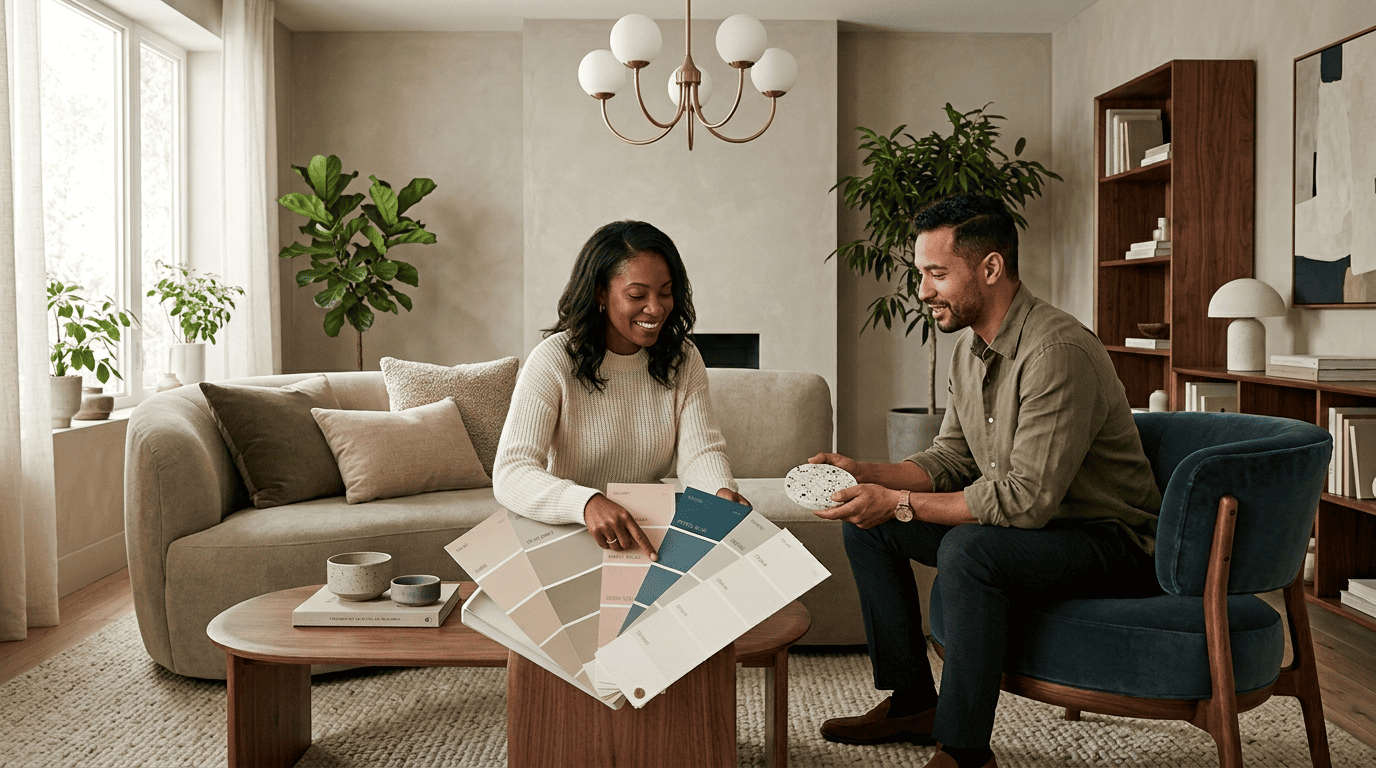
Organic Modern combines earthy tones, natural textures, and curved forms, and it remained one of the most in-demand interior styles through 2025 across major AI design platforms. That shift toward warmth carries into 2026 more broadly: palettes are trading the all-white look that dominated the 2010s for beige, sand, and olive tones, and the shift shows up in specific rooms too — 71% of designers agree their clients now prefer a colorful kitchen over the once-standard all-white one, according to the National Kitchen & Bath Association.
Maximalist, Transitional & Mediterranean
Maximalist rooms build on bold color and pattern layering rather than restraint, stacking prints, textures, and collected objects until the space feels intentionally full rather than cluttered. Transitional style bridges traditional and contemporary furniture in the same room, softening the edges of both. Mediterranean design leans on terracotta tones, arched doorways, and textured plaster walls, evoking coastal Southern Europe without copying any single region exactly.
How to Design Your Room With AI: Step by Step
Generating a first render takes only a few minutes once a photo is uploaded, and the workflow is largely the same across AI room design tools regardless of which of the 80+ styles gets selected.

The 4-step workflow
- Upload a clear, well-lit photo of the room to be redesigned.
- Pick a style — and, on most platforms, optionally specify the room type for more accurate furniture placement.
- Generate the render and review the multiple photorealistic variants the tool typically returns.
- Refine the result: adjust the color palette, re-roll for a new variant, or blend two styles together.
Tips for the best results
A handful of habits separate a usable render from a disappointing one:
- Shoot the room straight-on rather than at an angle, to avoid warped proportions in the render
- Declutter visible surfaces before photographing, since the AI tends to preserve existing clutter rather than remove it
- Generate two or three different styles for the same photo before deciding, rather than accepting the first result
- Save any shoppable palette or furniture list the platform offers, since matching real products later saves time
Have nothing in your houses that you do not know to be useful, or believe to be beautiful.
William Morris, textile designer and founder of the Arts and Crafts movement
That principle predates AI interior design by more than a century, but it still explains why a render full of unnecessary objects tends to feel worse than a sparse one, even when the sparse room is objectively less furnished. An AI tool that adds clutter for the sake of a «lived-in» look is optimizing for the wrong thing.

The practical fallout shows up whenever a style favors restraint. Minimalist and Scandinavian renders read as intentional rather than empty specifically because every remaining object earns its place, which is the same standard a human designer would apply by hand — just applied automatically and near-instantly by the AI.
A comparison across the most-requested styles makes it easier to see which one fits a given room before spending time generating renders:
| Style | Defining materials | Best suited for |
|---|---|---|
| Scandinavian | Light wood, neutral palette | Small or low-light rooms |
| Japandi | Natural materials, low furniture | Bedrooms, quiet living rooms |
| Mid-Century Modern | Curved wood, geometric patterns | Living rooms, statement pieces |
| Industrial | Brick, concrete, steel | Open-plan lofts, high ceilings |
| Coastal | Whites, blues, natural fiber | Sunrooms, guest rooms |
Choosing the Right Style for Your Space
The right style depends less on personal taste alone and more on how a room’s size and light interact with a given aesthetic’s proportions and palette.
Match style to room and light
Small or low-light rooms generally read better in Scandinavian or Minimalist styles, since the pale palettes and open floor space make them feel airier than they are. Open-plan layouts tend to suit Modern or Industrial styles, which are built around large, uninterrupted surfaces. A room meant as a cozy retreat — a bedroom or reading nook — usually benefits more from Japandi or Bohemian, both of which favor texture and warmth over openness. Because a render costs nothing but a few seconds, the most efficient approach is to A/B test two or three candidate styles on the same photo before committing any part of the renovation budget.
A quick way to narrow the shortlist before generating anything:
- Note the room’s natural light — north-facing rooms suit lighter, cooler styles better than dark, saturated ones
- Measure the floor plan — open layouts support bolder styles than a small, boxy room can carry
- Decide the room’s function first — a home office favors a calmer style than a living room built for entertaining
- List any furniture staying in the room, since the AI works around it rather than replacing it in restyle mode